
Awakening Cues
Author Daniel Coyle ignites the conversation around wholehearted AWARENESS

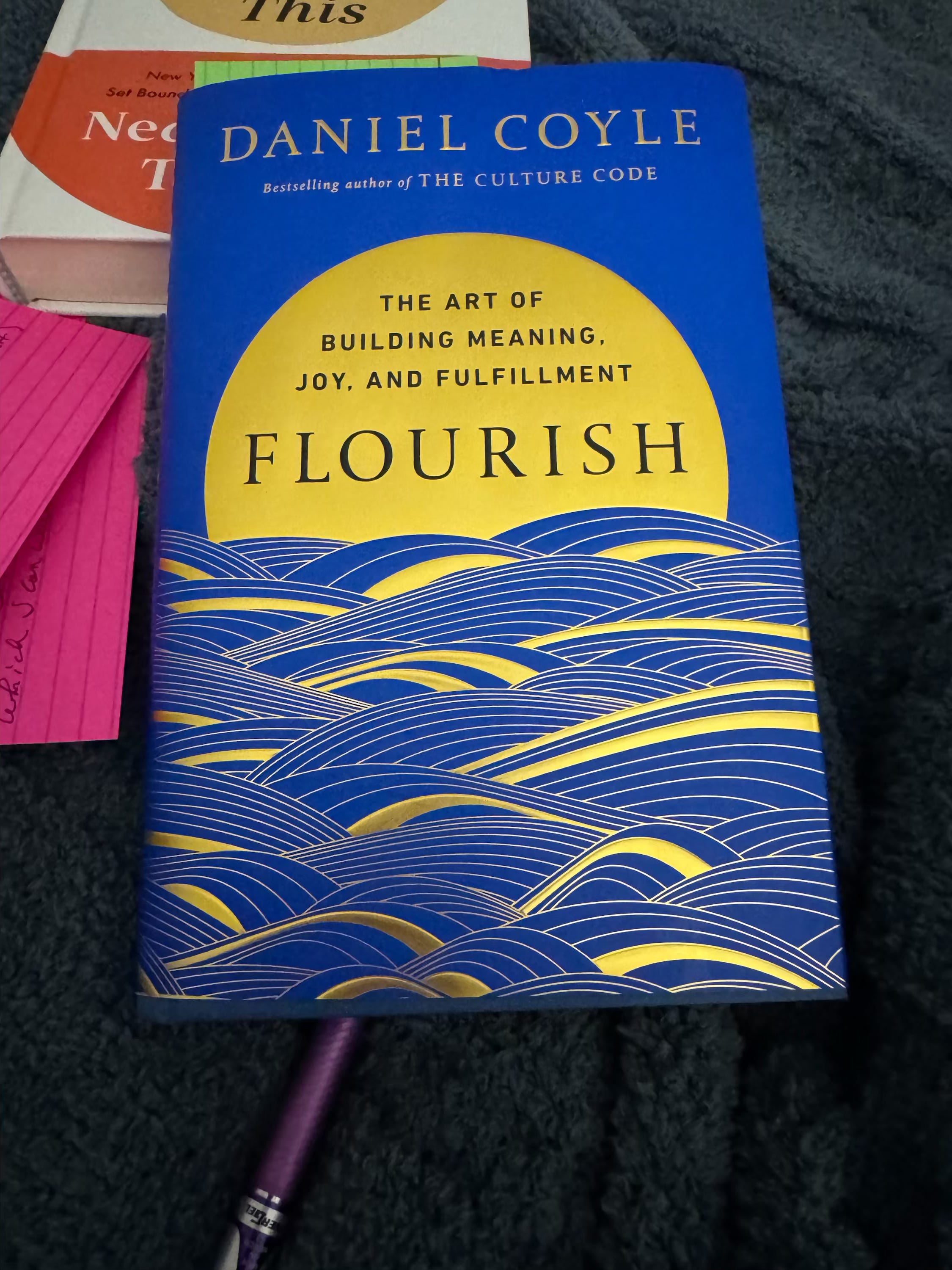
What if you wanted to spark more deep conversations, ideas, creative approaches to age old problems? Would you plant a few seeds or would you tap into something more powerful: awakening cues.
In his latest book, Flourish, Daniel Coyle opens the aperture and widens our perspective on how collective change takes hold in the real world.
Dan makes the point that too often when we can feel it in our bones that a change is sorely needed, we narrow our focus. The metaphor that comes to mind is the one of planting a seed. We take this amazing idea, dig a hole and pop that little brown seed into the ground, tamp it down and then wait — to see if it will sprout.
I can almost see Dan standing next to a circle of well-intentioned people all staring down at the flattened ground, growing restless while they wait for something to emerge. He would smile and say “let’s go for a walk - let’s look around and see the bigger picture.”
Daniel Coyle has long been a proponent of “awakening cues” to spark real change. He believes that we really are better together when it comes to a sweeping change that everyone can invests in; when people are united and ignited by a common goal.
He offers this profound wisdom: “The type of attention we bring to the world changes the world we find.”
Daniel points out that the real reason we aren’t making any headway with collective human issues like loneliness, isolation, addiction to devices, civil discourse and growing polarization is that we have dramatically narrowed our focus and attention. We are fixated on limited awareness.
In his book, Flourish, Daniel tells us that we honestly believe that focused attention is a powerful cognitive tool, a bright beam we use for understanding the world. The sharper the beam of attention and intense focus, the clearer the picture. It feels so counterintuitive to believe that broadening that beam would actually be more effective.
But that is the flex we need — the transformational pivot point. We need to zoom out and shine a much broader light on the full picture. It is only when we step back and awaken to the fact that we are all inextricably connected and that there is a very dynamic “cause and effect” ripple effect deepening our troubles — that we begin to see where we’ve gone wrong.
We’ve doubled down on what isn’t working. We falsely believe that narrowing our focus, putting the issues under a microscope and limiting our awareness to just a few tiny specks, will surely yield magical answers. We are looking in all the wrong places and for much too long.
Here is what Iain McGilchrist, a Scotland psychiatrist, philosopher and neuroimaging scholar at John Hopkins, offered to Daniel Coyle as he researched his book, Flourish:
“Flourishing groups aren’t succeeding because they’ve mastered the narrow beam but because they are better at letting go of it and tapping into the full, wholehearted awareness.”
He notes that the more we learn to soften our grip - to attune to awakening cues - the more we forge meaningful connection.
I like to think of this concept of awakening cues as a jenga tower. If we only focus on one piece at a time, we could ever so carefully extract it — but the whole tower could crash all at once. Stepping back and assessing possible moves more strategically can keep that tower intact for much longer and gives everyone a chance to participate.
In fact, Dan makes the point that we do need to use our two awareness tools with more skill, strategy and overarching understanding of the collective impact.
We need to perform two opposite but equally vital tasks:
Focus narrowly (narrow and logical)
Gaze broadly (wider and connective)
Dan admits that from a functional perspective, being able to do both of these simultaneously does form a riddle. How can you pay attention in two radically different ways?
If you only focus narrowly, you miss the bigger picture; if you only focus widely, you’ll miss savoring the details.
Yet - we do this quite naturally when we are steeped in a moment, when we are awestruck. The birth of child, falling in love, a deep friendship, a rainbow after a storm.
Dan describes “awakening cues” as moments of receptive stillness that create meaning by illuminating connection. It is much like when we were kids, connecting the dots in the page of workbook, and marveling that our penciled lines actually created an image.
Awakening cues are built on paradox: the more we surrender control, the more fully we connect.
Iain McGilchrist offers that “you let go, and by letting go, you connect”. “Stopping what you are doing and surrendering control is actually a very positive step, because it is opening a door that was previously closed.”
Let’s circle back to planting a seed and tamping down that ground, burying it. That is narrowing the focus. So often when we want someone or something to change, we plop a seed and talk too much. We think by driving home our point, somehow that outer shell of resistance will crack — and voila — something will sprout.
Daniel encourages us to try a new approach and think of awakening cues instead of planting seeds. This shift invites us all to drop our armor and to feel our way into something more expansive. Why does this change we want so badly matter?
Rarely do we stop long enough to really reflect on why something matters so deeply to us. We think we have to have quick answers. Ironically, those stock answers we give are often rooted in limiting beliefs, a need to be right, an assuredness that if we all did things “my way” there wouldn’t be a problem.
Daniel wants us to realize that seeking only answers drives people apart. Questions bring people together. Counterintuitive, right?
When we approach each other with a narrow focus of attention, we can trigger narrow and mechanical responses. Strong opinions rarely change and limiting worldviews keep us from seeing the bigger picture.
When we can step back and ask deep questions instead, we are encouraging others to drop the armor and drop into what matters most to them. The inner energy shifts. The conversations become dynamic, curious — this is connective tissue.
Daniel offers a lot of stories in his book Flourish to help us wrap our heads around this pivotal shift away from narrow beams of attention and into more wholehearted, expansive attention. My favorite one is his story of Mister Rogers - a shining example of someone who so skillfully invited both kids and adults to sink into what mattered most to them, to not only see but also feel that we are more alike than we are different; that when big news events happen that impact us all and make us feel scared, we should look for the helpers.
Take a little time today to think about how you might begin to incorporate awakening cues into your own life - and relationships. Can you zoom out from a disagreement and look at things from a broader perspective? Can you ask that friend or family member why something matters so much to them and be gracious enough to listen to understand?
Can you stop to think about what might happen in you get your own way — and it’s impact on others. Will your jenga tower still have integrity or will it crash? Is there a better way of handling a situation that becomes a pillar of strength, a win-win?
You can listen to Daniel Coyle talk about his newest book Flourish in this conversation with Adam Grant. Flourishing - with Daniel Coyle